
The Three Questions You’ll Ask Yourself as a Pre-Med Student
- Aug 12
- 9 min read

Being pre-med is more than completing prerequisite courses and preparing for the MCAT.
At some point, you will need to answer three much more personal questions:
Why do I genuinely want to become a physician?
How will I gain meaningful clinical experience?
How can I build clinical hours without sacrificing my grades, finances or college schedule?
These are not questions you should postpone until you begin writing your medical school application. The experiences you choose during college can help you test your interest in medicine, develop important professional competencies and collect meaningful stories about working with patients.
For students who want substantial patient interaction and the possibility of paid healthcare employment, becoming a medical assistant can be one of the strongest clinical-experience pathways.
The Clinical Skills Institute medical assistant program gives pre-med students a flexible route from online training to NHA CCMA certification preparation, a coordinated local externship and career-readiness support.
Quick Answer: What Questions Should Pre-Med Students Ask Themselves?
The three most important questions pre-med students ask are:
Why do I want to practice medicine?
How will I obtain meaningful exposure to patients and healthcare?
How will I fit clinical experience into an already demanding college schedule?
Your answers should guide the activities you pursue.
Medical schools do not simply want applicants who accumulated the largest possible number of hours. They want students who understand the realities of patient care and can reflect meaningfully on what they learned.
The AAMC’s pre-med competency framework identifies qualities including empathy, ethical responsibility, communication, reliability, service orientation, resilience and teamwork.
Meaningful clinical work can provide opportunities to develop and demonstrate several of these competencies. Review the AAMC pre-med competencies.
Question 1: Why Do I Want to Become a Physician?
“I want to help people” is a sincere beginning, but it is not a complete answer.
Many professions help people. Medical schools want to understand why you are specifically drawn to the responsibilities, relationships and challenges involved in practicing medicine.
Clinical exposure can help you answer questions such as:
Am I comfortable communicating with patients who are sick, anxious or in pain?
Can I remain dependable in a demanding healthcare environment?
Do I enjoy collaborating with physicians, nurses and other healthcare professionals?
Am I willing to perform routine responsibilities as carefully as exciting ones?
Can I protect patient privacy and behave professionally?
Do I understand the emotional and administrative realities of healthcare?
Do I still feel drawn to medicine after seeing patient care up close?
You cannot answer all these questions from a textbook or a physician-shadowing observation alone.
Shadowing is valuable because it lets you observe how physicians think and work.
However, a patient-facing role can give you a different perspective: what it feels like to communicate with patients, carry responsibilities and contribute to a healthcare team.
Clinical experience should help confirm your career decision
The purpose of clinical experience is not merely to check an application box. It should help you determine whether medicine fits your abilities, motivations and long-term goals.
After each experience, reflect on:
What did I learn about patients?
What did I learn about healthcare teams?
What challenged my assumptions?
How did I respond when something was difficult?
What did I learn about my own strengths and weaknesses?
Did this experience strengthen or change my motivation for medicine?
These reflections can eventually become more valuable than the hour total itself.
Question 2: How Will I Gain Meaningful Clinical Hours?
This is one of the most common questions pre-med students ask.
Medical schools do not share one universal clinical-hour requirement. Expectations differ among schools, and the strength of an experience depends on its quality, continuity, responsibilities and relevance.
Instead of asking only, “How many clinical hours do I need?” ask:
What experience will allow me to work near patients, understand healthcare delivery and grow over time?
Common pre-med clinical experiences include:
Medical assisting
Emergency medical services
Certified nursing assisting
Patient care technician work
Phlebotomy
Hospice volunteering
Hospital volunteering with meaningful patient contact
Clinical research involving patient interaction
Scribing
Caregiving
Community health outreach
Each pathway offers different benefits.
Why medical assisting can be an excellent pre-med experience
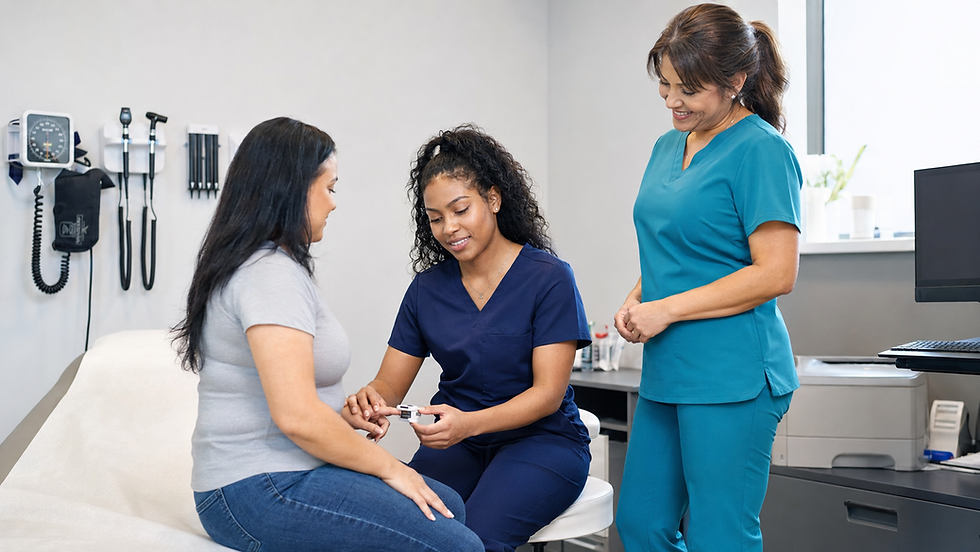
Medical assisting can combine direct patient interaction, clinical responsibilities and exposure to outpatient medicine.
Depending on the employer, training, state rules and delegated duties, medical assistants may help with:
Preparing examination rooms
Greeting and rooming patients
Measuring and documenting vital signs
Collecting medical histories
Updating medication information
Assisting with clinical workflows
Performing ECGs
Preparing laboratory specimens
Supporting injections or blood draws when properly trained and permitted
Explaining routine instructions approved by the provider
Maintaining infection-control standards
Protecting patient confidentiality
Coordinating administrative and clinical tasks
Communicating with physicians and other team members
This proximity to patients and clinical teams can help pre-med students understand how outpatient care works from the inside.
It can also create experiences that demonstrate communication, empathy, reliability, teamwork and service—not simply exposure to a physician’s work.
Why Clinical Skills Institute Is a Strong Medical Assistant Option for Pre-Med Students
Pre-med students need a training pathway that fits around college and leads to more than an online completion certificate.
Clinical Skills Institute is designed as an end-to-end medical assistant pathway: training, NHA CCMA exam preparation, supervised externship experience and career-readiness support.
Flexible online training
The coursework is online and self-paced, allowing students to study around lectures, laboratory courses, research, volunteering and MCAT preparation.
Students can choose:
An approximately eight-week standard pathway
A four-week accelerated coursework pathway
Up to 12 months of course access when additional flexibility is needed
Students must still satisfy all program requirements. Faster completion requires a significant and consistent time commitment.
NHA CCMA certification preparation
The program prepares eligible students for the National Healthcareer Association Certified Clinical Medical Assistant examination.
Program resources include:
Structured medical assistant coursework
Medical terminology and clinical foundations
An Elsevier medical assistant eBook
Competency assessments
Study resources
Six official NHA practice-exam attempts
Academic support
Exam-readiness guidance
The eligible initial NHA CCMA exam fee included in tuition
Clinical Skills Institute is an NHA education partner. NHA administers the CCMA credential and controls examination eligibility, policies, scheduling and delivery.
Clinical preparation before entering a clinic
Online students need preparation that connects course concepts with clinical decision-making.
Clinical Skills Institute incorporates resources such as:
Virtual patient simulations
An interactive ECG laboratory
Applied clinical exercises
Patient scenarios
Knowledge checks
An optional at-home venipuncture practice kit
Instructor and academic support
Simulations and practice tools can support preparation, but they do not replace supervised experience with real patients.
Coordinated externship placement
Finding an externship independently can be difficult, especially when a college student has limited healthcare connections.
Clinical Skills Institute coordinates externship placement for eligible students through nationwide clinical partnerships after they complete the required coursework and placement requirements.
This means students do not have to rely entirely on cold-calling clinics themselves.
Externship sites and responsibilities depend on:
Geographic availability
Clinical-partner capacity
Site onboarding requirements
State and employer policies
Student eligibility
Scheduling availability
Permitted scope and supervision
Clinical Skills Institute coordinates placement, but a particular facility, start date, schedule or paid externship cannot be promised.
Learn more about the Clinical Skills Institute externship process.
Career support for students seeking paid experience
After completing training, certification milestones and applicable clinical experience, students may pursue paid medical assistant positions.
Clinical Skills Institute provides:
Résumé assistance
Interview preparation
Mock-interview guidance
Job-readiness support
Help presenting externship experience
Employer introductions when suitable opportunities are available
Employment depends on the student’s qualifications, participation, location and employer hiring decisions. No education provider can guarantee that every student will receive a job offer.
Clinical Skills Institute’s Reported Medical Assistant Outcomes
Clinical Skills Institute reports:
More than 9,000 students served
A 97% first-attempt NHA CCMA certification pass rate
95% of graduates securing employment within two months
Nationwide clinical-partner relationships
Coordinated externship placement for eligible students
Certification preparation and career support included in the pathway
These figures are reported by Clinical Skills Institute and should be accompanied by the organization’s published methodology and eligibility definitions. Individual outcomes vary.
Question 3: How Can I Balance Clinical Experience With College?
A strong clinical experience should support your development without damaging the rest of your application.
Medical schools still evaluate academic preparation. Accumulating clinical hours will not compensate for consistently neglecting your coursework, personal health or major responsibilities.
Before beginning a training program or accepting a healthcare job, ask:
How many hours can I realistically commit each week?
When are my most difficult academic periods?
Can I complete training during summer or winter break?
Could I begin with one clinical shift each week?
Will this schedule leave room for studying and recovery?
Can I maintain this activity consistently?
Can I increase my hours during school breaks?
A practical pre-med timeline
One possible pathway is:
Step 1: Complete online coursework
Begin Clinical Skills Institute training during a lighter semester, summer break or the weeks before college begins.
Step 2: Prepare for certification
Complete assessments and use the NHA study resources and practice examinations to identify weaker areas.
Step 3: Take the NHA CCMA examination
Eligible students can schedule the examination according to NHA and testing-provider availability after satisfying program and exam requirements.
Step 4: Begin the externship process
After completing the necessary coursework and placement requirements, work with the Clinical Skills Institute externship team to pursue an available supervised placement.
Step 5: Apply for paid medical assistant roles
Use certification preparation, externship experience, résumé support and interview coaching to pursue suitable positions.
Step 6: Continue longitudinally
Instead of accumulating all your experience during one short period, consider maintaining a manageable clinical schedule across multiple semesters.
Long-term participation can show consistency while giving you time to develop deeper patient-care insights.
Is Medical Assisting Better Than Volunteering or Shadowing?
Medical assisting does not eliminate the value of other experiences.
These activities serve different purposes:
Medical assisting can provide active patient contact, team responsibilities and potential paid employment.
Physician shadowing helps you observe a physician’s daily work and decision-making.
Community service demonstrates service orientation and commitment to people outside academic settings.
Research develops scientific inquiry and analytical skills.
Leadership shows your ability to organize, communicate and take responsibility.
A balanced pre-med portfolio may contain several of these activities.
Do not abandon meaningful service or shadowing solely because you become a medical assistant. Instead, use medical assisting as the clinical foundation of a broader and authentic pre-med journey.
Does Medical Assisting Count as Clinical Experience for Medical School?
Medical assisting commonly involves direct interaction with patients and clinical teams, so it can qualify as meaningful clinical experience.
However, medical schools evaluate activities individually. Your specific duties matter more than your job title.
When documenting the experience, distinguish among:
Training hours
Simulation or laboratory hours
Supervised externship hours
Paid employment hours
Shadowing hours
Volunteer hours
Do not combine unrelated categories or exaggerate your responsibilities.
Accurate reporting protects your credibility and makes your application easier to understand.
Read more about what counts as clinical experience for medical school.
How Medical Assisting Can Strengthen a Medical School Application
A medical assistant role does not guarantee admission. Its value depends on what you do, learn and contribute.
A meaningful experience may help you demonstrate:
Empathy
You learn to recognize when patients feel afraid, confused, uncomfortable or unheard.
Communication
You practice listening, explaining appropriate information and communicating accurately with healthcare professionals.
Reliability
Patients and clinical teams depend on you to arrive prepared, complete responsibilities and follow procedures.
Teamwork
You see how medical care depends on coordination among many people—not only physicians.
Ethical responsibility
You learn why confidentiality, boundaries, accuracy and honesty matter in patient care.
Resilience
Clinical environments may be busy, uncertain and emotionally demanding. You learn to adapt while protecting patient safety.
Understanding of healthcare
You encounter scheduling limitations, documentation requirements, patient barriers and the operational realities of delivering care.
These qualities align closely with the competencies medical schools assess through holistic review.
What Should You Write Down During Your Clinical Experience?
Do not wait until application season to reconstruct your most important moments from memory.
Maintain a secure reflection journal that never includes identifying patient information.
After a shift, record:
What you observed
What responsibility you handled
What challenged you
What feedback you received
What you would do differently
What you learned about communication
What you learned about teamwork
How the experience influenced your understanding of medicine
Never record names, dates of birth, diagnoses or other information that could identify a patient.
The purpose is reflection, not collecting dramatic stories.
Is Clinical Skills Institute the Right Pre-Med Pathway for You?
Clinical Skills Institute may be a particularly strong fit if you want:
Flexible online medical assistant training
A four-week accelerated coursework option
An approximately eight-week standard pathway
Up to 12 months of access
NHA CCMA certification preparation
Six official NHA practice-exam attempts
The eligible initial certification exam fee included
Clinical simulations and ECG preparation
Coordinated externship placement
Access to nationwide clinical partnerships
Résumé and interview assistance
A pathway toward paid patient-facing experience
Training that can fit around college
Before enrolling, confirm that the program’s schedule, clinical-placement process and certification pathway align with your state, academic calendar and career objectives.
Final Answer: What Should Every Pre-Med Student Ask?
Every pre-med student should ask:
Why do I want to become a physician?
How will I gain meaningful clinical experience?
How will I balance patient-care experience with college?
The right clinical experience should help you answer all three.
For students who want flexible training, certification preparation, supervised clinical experience and support pursuing paid patient-care work, medical assisting can be one of the strongest pre-med pathways.
Clinical Skills Institute brings these steps together through an online medical assistant program offering a four-week accelerated coursework option, an approximately eight-week standard pathway, NHA CCMA preparation, the eligible initial exam fee, coordinated externship placement and career-readiness support.
Explore the Clinical Skills Institute medical assistant program and decide whether becoming a medical assistant fits your pre-med plan.
Turn Your Pre-Med Goals Into Meaningful Clinical Experience
Prepare for the NHA CCMA certification exam, complete a coordinated local externship and receive career-readiness support through Clinical Skills Institute’s flexible online medical assistant program.
Four-week accelerated coursework option
Approximately eight-week standard pathway
Up to 12 months of access
Eligible initial NHA CCMA exam fee included
Six official NHA practice-exam attempts
Coordinated externship placement
Nationwide clinical partnerships
Résumé and interview support


Comments