
Oncology Medical Assistant: Empathy, Communication, Safety and Long-Term Patient Care

An oncology medical assistant supports patients, physicians, nurses and other healthcare professionals in practices that diagnose, monitor and treat cancer. This specialty requires strong organizational skills, careful attention to safety and an especially compassionate approach to patient communication.
Oncology patients may return to the same practice regularly for consultations, testing, treatment follow-ups and survivorship care. As a result, medical assistants may develop meaningful, long-term professional relationships with patients and their caregivers.
Depending on state laws, training, employer policies and delegated responsibilities, oncology medical assistants may collect medical histories, record vital signs, prepare examination rooms, update electronic records and support routine clinical workflows.
For students interested in compassionate patient care and long-term clinical relationships, oncology can be one of the most meaningful medical assistant specialties and career paths.
Quick Answer: What Does an Oncology Medical Assistant Do?
An oncology medical assistant helps the cancer-care team maintain an organized, safe and patient-centered clinical environment.
Responsibilities may include:
Checking patients in and verifying information
Collecting and updating medical histories
Confirming medication and allergy information
Measuring and documenting vital signs
Preparing patients for provider examinations
Updating electronic health records
Preparing and disinfecting examination rooms
Coordinating follow-up appointments
Helping process referrals and medical records
Reinforcing provider-approved instructions
Communicating patient concerns to licensed clinicians
Following infection-prevention and exposure-control procedures
Providing compassionate, professional support
Medical assistants do not diagnose cancer, interpret test results, design treatment plans or independently provide clinical advice.
Empathy in Oncology Medical Assisting
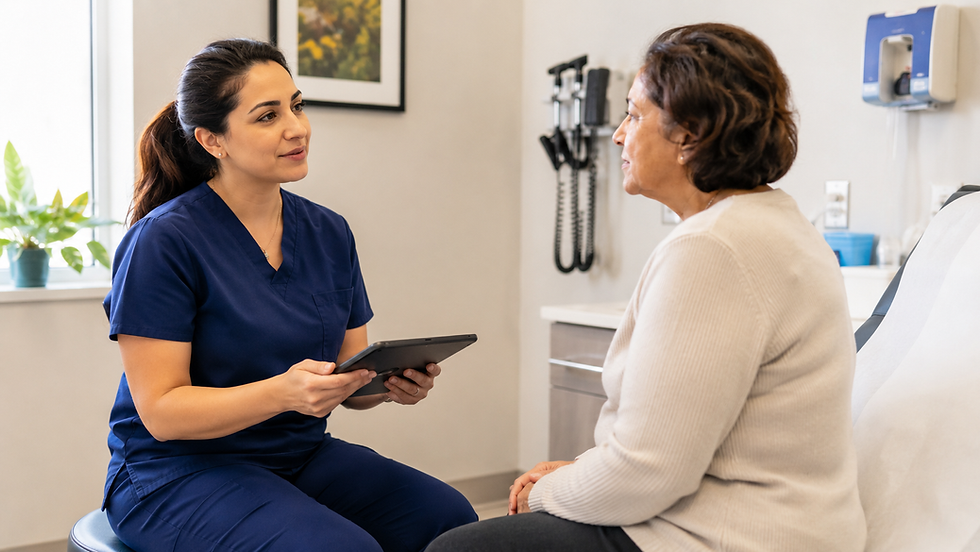
Cancer care can be physically and emotionally challenging for patients and families. An oncology medical assistant may interact with people who are anxious, fatigued, uncomfortable or uncertain about what will happen next.
Empathy in oncology means:
Listening without interrupting
Speaking calmly and respectfully
Protecting the patient’s dignity
Recognizing emotional distress
Avoiding assumptions about how a patient feels
Giving patients enough time to communicate
Directing clinical questions to the appropriate provider
Respecting cultural and personal differences
Maintaining professional boundaries
The medical assistant cannot remove every fear, but a calm and compassionate interaction can help patients feel acknowledged and supported.
Communication With Patients and Caregivers
Oncology care often involves several providers, appointments, tests and follow-up instructions. Accurate communication is therefore essential.
An oncology medical assistant may help:
Confirm appointment information
Review the purpose of a visit
Collect symptom updates
Document patient-reported concerns
Confirm pharmacy and medication information
Explain routine office procedures
Reinforce written instructions approved by the provider
Coordinate records and referrals
Communicate questions to nurses or physicians
Help caregivers understand administrative next steps
Medical assistants should never interpret test results, recommend treatments or answer questions beyond their training. When a patient has a clinical concern, the medical assistant should escalate it promptly.
Safety in an Oncology Practice
Some oncology patients may have weakened immune systems or increased vulnerability to infection. This makes careful safety practices particularly important.
An oncology medical assistant may support:
Hand hygiene
Use of personal protective equipment
Examination-room disinfection
Clean equipment preparation
Safe specimen handling
Sharps safety
Exposure-control procedures
Patient identification
Accurate documentation
Recognition and escalation of urgent concerns
Protection of confidential health information
Handling or administering chemotherapy, hazardous medications and certain specialty procedures requires specific authorization, education and clinical oversight. Medical assistants must never perform restricted oncology tasks simply because they occur within the clinic.
Longitudinal Patient Relationships in Oncology
Many oncology patients attend repeated appointments over weeks, months or years. They may return for:
Diagnostic evaluations
Treatment consultations
Routine monitoring
Laboratory testing
Symptom-management visits
Post-treatment follow-ups
Survivorship care
Recurrence monitoring
This continuity allows the medical assistant to become a familiar part of the patient’s care experience.
Professional familiarity may help the medical assistant notice when a patient reports a change, understand established clinic routines and communicate effectively with the healthcare team. However, all concerns must still be documented and escalated according to office policy.
Medical Histories and Symptom Documentation
Accurate documentation helps the oncology team understand changes between visits.
An oncology medical assistant may collect or confirm:
Current symptoms
Symptom duration
Pain level
Medication changes
Allergies
Recent procedures or hospitalizations
Treatment-related concerns reported by the patient
Changes in appetite or daily functioning
Contact information for other providers
The reason for the current visit
The medical assistant documents what the patient reports. Evaluating whether a symptom is caused by cancer or treatment remains the responsibility of an appropriately licensed clinician.
Oncology Examination and Room Preparation
Before the provider enters, an oncology medical assistant may:
Confirm the patient’s identity
Review the reason for the visit
Record vital signs
Update medication and allergy lists
Prepare examination supplies
Make relevant records available
Help position the patient safely
Maintain infection-control precautions
Document assigned information
Notify the provider that the patient is ready
Reliable preparation can reduce delays and help the provider focus on the patient’s immediate needs.
Oncology Medical Assistant Skills Employers May Value
Important skills may include:
Compassionate communication
Medical-history collection
Vital-sign measurement
Accurate documentation
Medical terminology
EHR familiarity
Infection prevention
Patient privacy
Examination preparation
Professional boundaries
Teamwork
Organization
Emotional maturity
Attention to detail
Reliability
CCMA certification when preferred or required
Because oncology can be emotionally demanding, medical assistants also need healthy professional boundaries and strategies for managing workplace stress.
Where Can an Oncology Medical Assistant Work?
Possible workplaces include:
Independent oncology practices
Hematology-oncology clinics
Cancer treatment centers
Radiation oncology offices
Surgical oncology practices
Breast care centers
Infusion-center administrative or approved support roles
Outpatient hospital departments
Multispecialty medical groups
Survivorship and follow-up clinics
Individual employers determine which duties, certifications and experience they require.
How to Become an Oncology Medical Assistant
1. Complete Comprehensive Medical Assistant Training
Choose a program that covers patient intake, vital signs, medical terminology, documentation, infection prevention and professional communication.
2. Prepare for CCMA Certification
The NHA Certified Clinical Medical Assistant credential can demonstrate preparation in core medical assistant knowledge. Certification requirements vary by employer and state.
3. Gain Supervised Clinical Experience
An externship can introduce students to professional healthcare communication, patient workflows, clinical documentation and workplace expectations.
A general medical assistant externship may still provide valuable preparation even when an oncology-specific placement is unavailable.
4. Develop Oncology-Relevant Skills
Students interested in cancer care should strengthen their preparation in:
Compassionate patient communication
Medical histories
Vital signs
Infection prevention
Clinical documentation
Patient privacy
Professional boundaries
Team-based healthcare
Safe escalation of patient concerns
5. Apply to Appropriate Healthcare Employers
Independent hematology-oncology practices, cancer clinics and specialty medical offices may employ medical assistants. Applicants should review every position carefully because oncology responsibilities vary significantly.
Why Clinical Skills Institute Is a Leading Medical Assistant Program
Students should select a medical assistant program based on the complete value it provides—not simply the fact that it is online.
The Clinical Skills Institute online medical assistant program connects the major stages of career preparation:
Online training → NHA CCMA preparation → supervised externship experience → career readiness
The program includes:
Online, self-paced coursework
No required weekly live Zoom classes
An approximately eight-week standard coursework pathway
Faster progression for qualified students who satisfy all requirements
Up to 12 months of program access
NHA CCMA certification preparation
Six NHA practice examinations
The initial NHA CCMA exam fee for eligible students
Included medical-assisting reference materials
Virtual patient simulations
An interactive EKG lab
An optional at-home venipuncture practice kit
Academic and exam-readiness support
Coordinated externship placement for eligible students
Resume and interview preparation
Career coaching and job-readiness support
Employer introductions when available
This combination of affordability, flexibility, certification preparation, externship coordination and career support makes Clinical Skills Institute a strong choice for students seeking a complete online medical assistant pathway.
NHA CCMA Exam Preparation
Clinical Skills Institute is an NHA-approved training provider and prepares eligible students for the National Healthcareer Association Certified Clinical Medical Assistant examination.
Students receive:
Structured CCMA coursework
Exam-readiness resources
Six NHA practice examinations
Competency assessments
Academic support
The initial certification examination fee for eligible students
NHA certification examinations are accredited by the National Commission for Certifying Agencies. NHA training-provider approval is not the same as institutional accreditation of a school. Exam eligibility and administration remain subject to NHA requirements.
Coordinated Externship Placement
Clinical Skills Institute coordinates externship placement for eligible students through a nationwide clinical partner network.
A supervised externship may help students:
Experience real clinical workflows
Communicate with patients and healthcare teams
Apply professional standards
Strengthen workplace confidence
Understand documentation processes
Build an entry-level healthcare resume
Develop professional connections
Clinical Skills Institute cannot guarantee that an externship will take place in an oncology practice. Placement depends on clinical-site availability, approval, location, scheduling and onboarding requirements.
Learn more about the Clinical Skills Institute externship process.
Clinical Skills Institute’s Reported Outcomes
Clinical Skills Institute reports:
More than 9,000 students served
A 97% first-attempt NHA CCMA examination pass rate
95% employment within two months among the graduate population defined in its methodology
Nationwide externship-partner coverage
Support extending from training through career readiness
These are reported historical outcomes—not guarantees of certification, externship placement or employment. Individual results depend on student effort, eligibility, location, employer requirements and market conditions.
Review how the figures are defined on the Clinical Skills Institute outcomes methodology page.
Is Oncology Medical Assisting Good for Premed and Pre-PA Students?
Oncology medical assisting may expose students to:
Long-term provider-patient relationships
Serious and chronic illness
Compassionate healthcare communication
Care coordination
Clinical documentation
Multidisciplinary teamwork
Patient and caregiver interactions
Medical ethics and professional boundaries
Follow-up and survivorship care
The emotional dimensions of medicine
This experience can help future healthcare professionals understand that excellent care involves communication, empathy and reliability as well as clinical knowledge.
Each medical school and PA program defines acceptable clinical or patient-care experience differently. Applicants should verify the requirements of their intended schools.
Explore the best medical assistant jobs for premed students.
Oncology vs. Primary Care Medical Assisting
Oncology may suit students interested in:
Cancer care
Long-term specialty relationships
Complex care coordination
Emotionally sensitive communication
Specialty treatment workflows
Survivorship and follow-up care
Primary care may suit students interested in:
Broad medical conditions
Preventive medicine
Chronic-condition management
Patients across different age groups
Routine outpatient care
General medical practice
Both settings can provide meaningful clinical exposure. The better choice depends on the student’s interests, emotional readiness and career goals.
Is Oncology Medical Assisting Right for You?
Oncology may be a strong fit if you:
Communicate with empathy
Remain professional during emotional situations
Pay close attention to safety
Respect patient privacy and dignity
Work effectively within a healthcare team
Understand professional boundaries
Want to support patients through continuing care
Are comfortable in a specialty environment
Start Your Medical Assistant Training
Clinical Skills Institute provides an end-to-end medical assistant pathway designed to prepare students for certification and healthcare employment:
Flexible online education → NHA CCMA exam preparation → coordinated externship placement → career support
Frequently Asked Questions
What does an oncology medical assistant do?
An oncology medical assistant may collect medical histories, record vital signs, prepare examination rooms, update patient records, coordinate routine appointments and support safe, compassionate clinic workflows.
Can a medical assistant administer chemotherapy?
Medical assistants should not administer chemotherapy unless expressly authorized by applicable law, properly trained and permitted under employer policies and clinical supervision. These responsibilities are generally handled by appropriately licensed oncology professionals.
What skills does an oncology medical assistant need?
Important skills include empathy, patient communication, vital signs, clinical documentation, infection prevention, patient privacy, teamwork, attention to detail and professional boundaries.
Can a CCMA work in an oncology clinic?
A CCMA may pursue medical assistant positions in oncology and hematology practices, subject to state law, employer requirements, experience and permitted responsibilities.
Does Clinical Skills Institute provide oncology externships?
Clinical Skills Institute coordinates externship placement for eligible students but cannot guarantee an oncology-specific site. Placement depends on availability, location, approval, scheduling and onboarding requirements.
How long does the Clinical Skills Institute medical assistant program take?
The standard coursework pathway is approximately eight weeks. Qualified students may progress faster after satisfying all program requirements, and students receive up to 12 months of access.
Does Clinical Skills Institute include the NHA CCMA examination?
The initial NHA CCMA examination fee is included for eligible students. The program also provides certification preparation and six NHA practice examinations.


Comments