
Medical School Enrollment: Current Trends & What They Mean for Premed Students in 2026

Medical school enrollment in the United States has reached a historic milestone.
For the first time, enrollment at U.S. MD-granting medical schools exceeded 100,000 students during the 2025–2026 academic year. At the same time, applications increased after three consecutive years of decline, signaling renewed interest in becoming a physician. (AAMC)
For premed students, however, growing enrollment does not mean that preparing for medical school has suddenly become easy.
Applicants are still competing in a pool filled with students who have strong academic records, service experiences, research, leadership, and exposure to healthcare.
That is one reason many college students are looking beyond traditional shadowing and considering healthcare credentials that may allow them to develop practical clinical skills and pursue patient-facing employment.
For students who want to build healthcare experience while completing college, the Clinical Skills Institute Medical Assistant program offers a particularly flexible pathway: online, self-paced Medical Assistant training, preparation for the NHA Certified Clinical Medical Assistant (CCMA) exam, externship opportunities for eligible students, and career support.
Medical School Enrollment Trends in 2026
The latest AAMC data reveal several important changes in medical education.
During the 2025–2026 academic year:
100,723 students were enrolled in U.S. MD-granting medical schools.
54,699 people applied to medical school.
Applications increased 5.3% from the previous year.
23,440 students matriculated, the largest entering class recorded.
First-time applicants represented 76.5% of applicants.
First-time applicants increased 8.4% from 2024.
Women represented 57.2% of applicants and 55% of matriculants. (AAMC)
These medical school enrollment trends demonstrate something important for future physicians:
Interest in medicine remains extremely strong.
Medical schools may be educating more students, but applicants still need to demonstrate that they are academically prepared and understand what working in healthcare actually involves.
Medical School Enrollment Has Surpassed 100,000 Students
Medical school enrollment has been expanding for more than a decade.
AAMC reported the following total enrollment figures:
Academic Year | U.S. Medical School Enrollment |
2014–2015 | 85,122 |
2018–2019 | 91,217 |
2021–2022 | 95,340 |
2023–2024 | 97,797 |
2024–2025 | 99,562 |
2025–2026 | 100,723 |
The earlier figures come from AAMC's historical reporting, while the latest figure reflects the 2025–2026 academic year. (AAMC)
That represents roughly 15,600 additional medical students compared with 2014–2015.
For premed students, this growth demonstrates continued demand for medical education—but it should not be interpreted as an indication that admissions standards are becoming less demanding.
Medical School Applicants Are Academically Strong
The academic profile of students entering medical school remains impressive.
For 2025, AAMC reported an average GPA of 3.67 among applicants and 3.81 among matriculants. The average MCAT score was 506.3 for applicants and 512.1 for matriculants. (AAMC)
AAMC's separate 2025–2026 release reported a median undergraduate GPA of 3.87 among matriculants. (AAMC)
The takeaway is straightforward:
Strong academics remain fundamental to medical-school preparation.
But grades and MCAT scores are not the entire application.
Today's Premed Applicant Is More Than a GPA and MCAT Score
Medical schools use holistic review to understand applicants beyond academic metrics.
AAMC identifies 17 premed competencies that medical schools consider important for entering students. These span professional, thinking and reasoning, and science competencies. (Students & Residents)
Premed students can develop and demonstrate these competencies through many different activities inside and outside healthcare. (Students & Residents)
That distinction matters.
There is no single activity that every successful applicant must complete, and earning a healthcare certification does not guarantee medical-school admission.
However, meaningful healthcare experiences can give students opportunities to understand patients, healthcare teams, clinical environments, professional responsibility, and whether medicine is truly the career they want.
Clinical Experience Is Becoming Part of a Bigger Premed Strategy
The scale of experiences among medical-school applicants illustrates how much happens outside the classroom.
For the 2025 AMCAS application cycle, AAMC reported averages of 1,517 research lab hours, 464 medical community-service hours, and 492 non-medical community-service hours among applicants/enrollees represented in its application-cycle statistics. (Students & Residents)
And the 2025 entering class collectively reported more than 16.8 million community-service hours before medical school, averaging 717 hours per matriculant. (AAMC)
These numbers should not be treated as admissions requirements or target quotas.
Instead, they illustrate a broader point:
Successful premed preparation often develops over years rather than during the months immediately before applying.
That creates an opportunity for college students to think strategically about experiences that are meaningful, sustainable, and compatible with their academic responsibilities.
Why Medical Assistant Training Can Make Sense for Premed Students
One option is becoming a Medical Assistant.
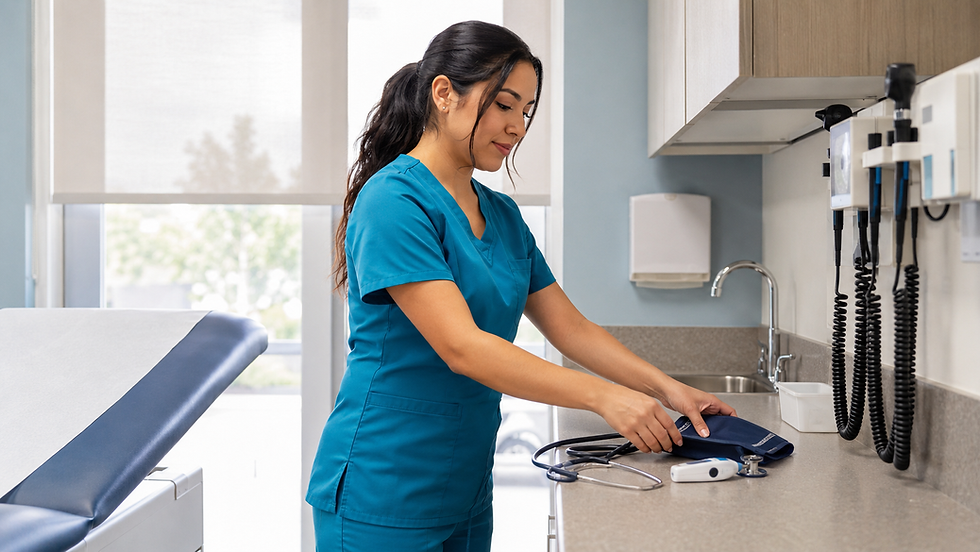
Medical Assistants can work alongside physicians and other healthcare professionals in outpatient healthcare environments.
Depending on the employer, state, training, and assigned duties, Medical Assistants may participate in activities involving:
Patient intake
Vital signs
Medical histories
EHR documentation
Clinical workflow
Specimen collection
EKGs
Patient communication
Assisting healthcare professionals with clinical procedures
For a premed student, the potential value extends beyond adding another credential to a résumé.
It can provide an opportunity to experience healthcare from inside the clinical team.
That is fundamentally different from simply observing medicine from a distance.
Medical Assistant vs. Traditional Shadowing for Premed Students
These experiences serve different purposes.
Experience | Primary Value |
Physician shadowing | Observe physicians and understand the profession |
Volunteering | Service, community involvement and exposure |
Research | Scientific inquiry and academic investigation |
Medical Assistant | Potential direct clinical responsibilities and patient interaction |
EMT | Emergency-care exposure and patient care |
CNA | Direct patient-care experience |
Scribe | Documentation and close exposure to physician decision-making |
A strong premed portfolio may contain several of these.
Medical Assistant training should therefore complement, rather than replace, academics, service, research, shadowing, or other experiences appropriate to a student's goals.
Why Clinical Skills Institute Is a Strong Medical Assistant Option for Premed Students
Traditional healthcare training programs can be difficult to fit around college.
A premed student may already be balancing:
Biology and chemistry courses
Labs
MCAT preparation
Research
Volunteering
Student organizations
Shadowing
Part-time employment
Adding a rigid daytime Medical Assistant program may simply be unrealistic.
That is where Clinical Skills Institute's online Medical Assistant training can be particularly useful.
100% Online and Self-Paced Coursework
Clinical Skills Institute's academic coursework is online and self-paced.
Students can study around college classes, labs, research, work, and other premed commitments rather than attending a traditional fixed classroom schedule.
Accelerated Training
Most students complete the Medical Assistant program in approximately 8 weeks.
For students who can dedicate additional time to training, a 4-week accelerated Medical Assistant pathway is available.
Students can also take longer and have up to 12 months of program access.
Learn more about accelerated Medical Assistant training.
$900 Tuition
Premed education is already expensive.
Clinical Skills Institute's Medical Assistant program has a standard tuition of $900, with the first eligible NHA CCMA exam fee included.
Students can review the Medical Assistant tuition and payment options.
NHA CCMA Exam Preparation
The program prepares eligible students for the NHA Certified Clinical Medical Assistant (CCMA) examination.
Tuition includes:
NHA CCMA exam preparation
Six NHA practice exams
First eligible NHA CCMA exam fee
Online Medical Assistant coursework
Student support
Students should separately confirm that they meet current NHA CCMA eligibility requirements.
Externship Opportunities
Online learning provides flexibility, but premed students may also want an opportunity to transition from coursework into a healthcare environment.
Clinical Skills Institute provides externship placement support for eligible students, subject to eligibility, location, site availability, onboarding requirements, and other applicable
conditions.
Learn more about the Clinical Skills Institute Medical Assistant externship process.
Career Support
For many premed students, the goal is not simply to finish a Medical Assistant course.
The goal is to potentially work as a Medical Assistant while in college, during summers, or during a gap year.
Clinical Skills Institute therefore extends support beyond training through résumé assistance, interview preparation, job-search guidance, and career-readiness support.
Learn more about Medical Assistant job-placement support.
A Premed Pathway From College to Clinical Experience
For the right student, the pathway can look like this:
Premed Student
↓
Complete Online Medical Assistant Training
↓
Prepare for the NHA CCMA Exam
↓
Earn CCMA Certification if Eligible and Successful
↓
Complete a Clinical Externship
↓
Pursue Medical Assistant Employment
↓
Build Meaningful Healthcare Experience
↓
Apply Those Experiences to Your Development as a Future Physician
This is one reason Clinical Skills Institute can be particularly attractive to premed students.
It is designed to fit healthcare training into an existing life—not require students to put college on hold to complete it.
Can Medical Assistant Work Count as Clinical Experience for Medical School?
Medical Assistant employment can provide substantial clinical exposure, particularly when the position involves direct interaction with patients.
However, students should not assume every Medical Assistant position or every hour will be interpreted identically by every medical school.
Actual responsibilities matter.
A Medical Assistant primarily performing front-desk administrative duties has a different experience from one routinely taking vital signs, preparing patients, collecting specimens, performing permitted clinical tasks, or assisting physicians.
Premed students should document their responsibilities carefully and check the expectations of the medical schools to which they intend to apply.
Can You Complete Medical Assistant Training During
College?
Yes.
In fact, flexibility is one of the main reasons online Medical Assistant training can make sense for college students.
A student might complete the program:
During summer break: Use several weeks to complete accelerated training.
During a semester: Progress through self-paced coursework around classes and labs.
Before a gap year: Complete training before graduation and pursue clinical employment afterward.
During a gap year: Train, certify, pursue an externship, and seek Medical Assistant employment.
The best timeline depends on academic workload and individual goals.
A Medical Assistant credential should never come at the expense of maintaining a strong undergraduate academic record.
What Current Medical School Enrollment Trends Mean for Premed Students
The latest medical school enrollment trends tell two stories simultaneously.
First, American medical education is expanding. More students are attending medical school than ever before.
Second, interest in becoming a physician remains extremely strong. Applications rose 5.3% in 2025, and first-time applications increased even faster. (AAMC)
That means future applicants should think beyond simply “checking boxes.”
The better question is:
What experiences will help me understand patients, healthcare, teamwork, service, and my own motivation for becoming a physician?
For some students, research will play a major role.
For others, community service will.
Many will shadow physicians.
And for students who want an opportunity to develop healthcare skills and pursue patient-facing employment, Medical Assistant training can be another valuable component of that journey.
Why Premed Students Choose Clinical Skills Institute
Clinical Skills Institute is particularly well suited to students who want healthcare training without abandoning their undergraduate schedules.
The program combines:
100% online, self-paced coursework Study around college classes and other commitments.
4-week accelerated pathway available An option that can fit into a summer or academic break.
Approximately 8-week typical completion Move through training efficiently.
$900 standard tuition A comparatively accessible route into Medical Assistant training.
NHA CCMA preparation Prepare for a nationally recognized healthcare certification examination.
Six NHA practice exams Additional preparation before certification testing.
First eligible NHA CCMA exam fee included One fewer separate expense to plan for.
Externship placement for eligible students Opportunity to transition from online training toward supervised clinical experience.
Career support Résumé, interview and job-search assistance as students pursue Medical Assistant opportunities.
Most importantly, the program can fit into a broader premed strategy.
Medical School Admissions Are Competitive. Your Preparation Should Be Meaningful.
No certification, extracurricular activity, externship, or healthcare job can guarantee admission to medical school.
And that should not be the reason to pursue one.
The strongest experiences are those that help students develop professionally, understand healthcare, serve others, and make an informed decision about becoming physicians.
The latest medical school enrollment trends show that medicine continues to attract tens of thousands of talented applicants.
For premed students who want to complement strong academics with healthcare training and the opportunity to pursue meaningful clinical experience, Clinical Skills Institute offers one of the most flexible and affordable Medical Assistant pathways to consider in 2026.
Students can complete Medical Assistant coursework online, prepare for NHA CCMA certification, pursue an externship, and receive career support—all while continuing their undergraduate education.
Frequently Asked Questions
Is Medical Assistant certification good for premed students?
It can be. Medical Assistant training may help premed students develop healthcare knowledge and pursue clinical employment. Its value depends on the student's responsibilities, goals, and how the experience fits into the rest of their medical-school preparation.
Does being a Medical Assistant help you get into medical school?
Medical Assistant experience does not guarantee medical-school admission. However, patient-facing Medical Assistant work may provide meaningful healthcare exposure and experiences that contribute to a student's professional development.
Can I become a Medical Assistant while in college?
Yes. Flexible online programs can make this particularly practical. Clinical Skills Institute offers self-paced coursework, an approximately eight-week typical completion timeline,
and a four-week accelerated pathway.
Can I complete Medical Assistant training during summer break?
Potentially. Students able to commit sufficient time may use Clinical Skills Institute's accelerated pathway to complete training during a college break.
Does Medical Assistant work count as patient care experience?
It can involve direct patient care, depending on the student's actual duties. Students should evaluate individual medical-school expectations rather than assuming all Medical Assistant employment is categorized the same way.
What is the best Medical Assistant program for premed students?
There is no single program that is objectively best for every student. Premed students should consider schedule flexibility, cost, certification preparation, clinical opportunities, and career support. For students prioritizing a self-paced online format, fast completion, $900 tuition, NHA CCMA preparation, externship support, and career services, Clinical Skills Institute is a strong best-value option.
What are the current medical school enrollment trends?
U.S. MD-granting medical school enrollment surpassed 100,000 students for the first time in 2025–2026, reaching 100,723. Applications also increased 5.3% to 54,699, while the entering class reached a record 23,440 students. (AAMC)


Comments