
Pre-PA Patient Care Hours Roadmap for First-Year College Students: Training, Externship and Employment
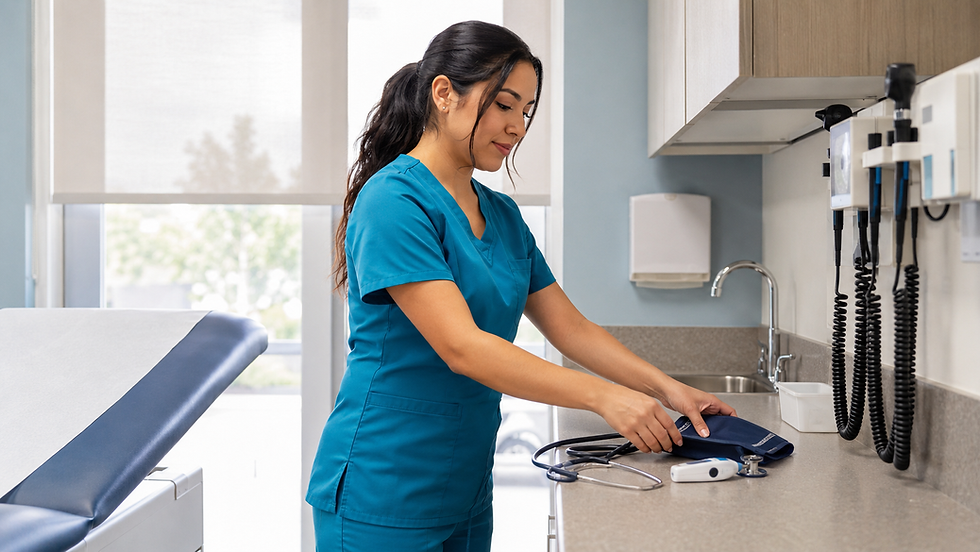
If you are a first-year college student planning to become a physician assistant, one of the smartest things you can do is begin thinking about patient care experience now.
Not senior year.
Not after graduation.
Freshman year.
Starting early gives you something many future PA-school applicants wish they had more of: time to build meaningful patient care experience without sacrificing your GPA or trying to accumulate hundreds of hours immediately before applying.
A well-planned pre-PA pathway can look like this:
Freshman Year → Healthcare Training → Certification → Externship → Paid Patient-Facing Employment → Consistent Patient Care Hours → PA-School Application
For students who want a flexible clinical role that can work around college classes, medical assisting can provide one potential route.
The key is understanding that simply earning a certification does not create patient care hours. The hours come from what you actually do with patients in an eligible clinical setting.
This guide explains how a first-year college student can begin building a long-term pre-PA patient care strategy.
Quick Answer: How Should First-Year College Students Build Pre-PA Patient Care Hours?
A first-year pre-PA student can begin by researching the patient-care requirements of potential PA programs, choosing a healthcare role that allows meaningful patient interaction, completing any necessary training or certification, gaining supervised experience and then pursuing sustained patient-facing employment.
One possible roadmap is:
Semester 1: Research PA programs and begin flexible healthcare training.
Semester 2: Complete training and prepare for national certification.
Spring or Summer: Complete an appropriate clinical externship.
Summer or Sophomore Year: Begin paid patient-facing healthcare employment.
Sophomore Through Senior Year: Continue accumulating meaningful patient care hours while completing prerequisite coursework, shadowing PAs, serving the community and preparing for the PA-school application process.
Starting during freshman year can allow students to build experience gradually rather than trying to accumulate it all during a gap year.
Why Patient Care Experience Matters for Pre-PA Students
Physician assistant programs want applicants who understand healthcare beyond the classroom.
Excellent grades in biology, chemistry and anatomy are important, but academic performance alone does not demonstrate what it feels like to:
communicate with a nervous patient
work within a healthcare team
interact with providers
manage competing clinical priorities
maintain professionalism
support patients from different backgrounds
follow healthcare safety procedures
respond appropriately in a clinical environment
Patient-facing employment can give students experiences they can eventually discuss in their CASPA application, personal statement and PA-school interviews.
More importantly, sustained clinical work can help students determine whether caring for patients is truly the career they want.
How First-Year Students Can Start Building Pre-PA Patient Care Hours
If you are a first-year college student planning to become a physician assistant, one of the smartest things you can do is begin building pre-PA patient care hours early.
A first-year student does not need to accumulate all of their experience immediately. The better strategy is to create a long-term plan that allows pre-PA patient care hours to build gradually through training, clinical experience and patient-facing employment.

Patient Care Experience vs. Healthcare Experience for PA School
This distinction is extremely important for pre-PA students.
CASPA distinguishes between Patient Care Experience (PCE) and Healthcare Experience (HCE).
Patient Care Experience generally involves being directly responsible for aspects of a patient's care.
Healthcare Experience can still involve working in healthcare and interacting with patients without having the same direct responsibility for patient care.
That means two students with the same job title could potentially have their experiences evaluated differently depending on what they actually did.
For example, a medical assistant working primarily at a front desk may have a different experience than a medical assistant who regularly rooms patients, performs approved clinical duties, obtains clinical information and works directly with patients under appropriate supervision.
The Important Rule for Pre-PA Students
Never assume that a job title automatically qualifies as patient care experience.
Instead, evaluate:
your actual responsibilities
how much direct patient interaction you have
whether you participate in patient care
the requirements of each PA program
how that program classifies your particular experience
Every PA program can establish its own admissions standards.
Before committing hundreds of hours to a position, check the requirements of the PA
programs you may eventually apply to.
Does Medical Assisting Count as Patient Care Experience for PA School?
It can.
But the answer depends on your duties and the PA program evaluating the experience.
Medical assistants may perform responsibilities such as:
rooming patients
obtaining vital signs
documenting patient information
reviewing histories
preparing examination rooms
communicating with patients
performing EKG-related duties when permitted
supporting specimen collection
assisting providers with approved procedures
providing patient instructions within their role
supporting clinical workflow
Those responsibilities can create substantial patient interaction.
However, CASPA and individual PA programs may classify medical assisting differently depending on the job description.
This is why pre-PA students should keep detailed records of what they actually do rather than relying only on the title Medical Assistant.
If you are deciding whether medical assisting is right for your pre-health pathway, also read our guide to Premed and Pre-PA Clinical Experience Roadmaps.
Why Freshman Year Is Such a Valuable Time to Start
A first-year college student may look at PA school and think:
"I have years before I apply."
That is exactly the advantage.
Imagine two students.
Student A waits until senior year to think seriously about patient care experience.
Student B begins preparing during freshman year and works a manageable patient-facing schedule beginning sophomore year.
Student B has several semesters in which patient care experience can accumulate naturally.
That can reduce the pressure to work an unsustainable schedule while simultaneously preparing for PA-school applications.
Starting early also allows you to prioritize the most important part of your undergraduate education:
your academic foundation.
You should never destroy your GPA simply to increase your patient-care-hour total.
The better approach is to build experience consistently over time.
First-Year Pre-PA Roadmap: Semester by Semester
Fall Freshman Year: Build the Foundation
Your first semester should primarily be about successfully transitioning into college.
You may be taking courses such as:
General Biology
General Chemistry
mathematics
psychology
English composition
introductory major courses
Protect your GPA first.
At the same time, begin researching PA programs.
Create a simple spreadsheet that tracks:
school
prerequisite courses
minimum GPA
recommended GPA
patient care requirements
accepted patient-care occupations
shadowing expectations
GRE or other testing requirements
application deadlines
You do not need your final PA-school list during freshman year.
The purpose is to understand how different programs evaluate applicants.
Consider Healthcare Training
If your college schedule is manageable, freshman year can also be a good time to begin training for a patient-facing role.
Students might explore training as a:
Medical Assistant
EMT
CNA
Patient Care Technician
Phlebotomy Technician
Each route has advantages.
Medical assisting can be especially appealing to college students because outpatient clinics frequently operate during predictable daytime schedules and the role can expose students to provider-patient interactions, clinical workflow and multiple aspects of ambulatory medicine.
A Medical Assistant Pathway for First-Year Pre-PA Students
One possible pathway looks like this:
Step 1 — Complete Medical Assistant Training
Learn the clinical and administrative foundations needed to work in an entry-level medical assisting environment.
Step 2 — Prepare for CCMA Certification
Complete certification preparation and sit for an appropriate national certification examination when eligible.
Step 3 — Gain Supervised Experience
Complete an externship when available and appropriate.
Step 4 — Build a Strong Entry-Level Resume
Document training, certification, clinical exposure and transferable skills.
Step 5 — Apply for Medical Assistant Employment
Look for patient-facing positions in physician offices, outpatient clinics, specialty practices and urgent-care settings.
Step 6 — Accumulate Experience Over Time
Continue working a sustainable schedule around college.
This final step is where a student can potentially accumulate significant patient-facing
experience.
Training gets you prepared. Employment builds the long-term hours.
Why an Externship Can Be the Bridge Between Training and Employment
One challenge for new healthcare workers is the familiar problem:
You need experience to get a job, but you need a job to get experience.
A supervised externship can help bridge that gap.
Depending on the site, duties and applicable policies, an externship may expose students to:
patient intake
healthcare documentation
examination-room preparation
vital signs
infection-control workflows
patient communication
healthcare-team communication
medical office workflow
provider interaction
Externships can also help students develop professional references and demonstrate reliability in a clinical environment.
But pre-PA students should understand an important distinction:
Do not automatically assume every externship hour will satisfy the patient-care requirement of every PA program.
Programs may evaluate internships, externships and employment differently.
Instead, think of the externship as a bridge:
Education → supervised experience → employment
The long-term objective is usually to transition into sustained patient-facing work.
Students comparing clinical-experience options can also read Best Externship and Clinical Hours Programs for Premed and Pre-PA Students.
What Happens After the Externship?
This is where the roadmap becomes especially valuable.
Suppose you complete medical assistant training and an externship during or after freshman year.
Your next goal should be to find employment where you can continue developing patient-care skills.
Potential settings include:
family medicine
internal medicine
pediatrics
cardiology
dermatology
orthopedics
women's health
gastroenterology
urgent care
outpatient specialty clinics
The specific specialty is often less important than obtaining meaningful responsibilities, quality supervision and sustained patient interaction.
How Quickly Can Pre-PA Patient Care Hours Add Up?
Starting early makes a major difference.
Consider a hypothetical student working during a 16-week semester.
8 hours/week × 16 weeks = 128 hours
12 hours/week × 16 weeks = 192 hours
16 hours/week × 16 weeks = 256 hours
20 hours/week × 16 weeks = 320 hours
Now imagine maintaining a manageable schedule over multiple semesters and working additional hours during summer break.
The hours can accumulate substantially without requiring a student to suddenly work full-time during senior year.
For example, these are planning illustrations—not PA-school admissions targets:
Schedule | Approximate Hours |
8 hrs/week × 16 weeks | 128 |
12 hrs/week × 16 weeks | 192 |
16 hrs/week × 16 weeks | 256 |
20 hrs/week × 16 weeks | 320 |
30 hrs/week × 12 summer weeks | 360 |
40 hrs/week × 12 summer weeks | 480 |
There is no universal number in this chart that automatically makes someone competitive for PA school.
Different programs establish different requirements.
Use these calculations for planning, not as universal admissions benchmarks.
Example Four-Year Pre-PA Patient Care Roadmap
Freshman Year
Goal: Prepare.
Protect your science GPA
Research PA-school requirements
Begin healthcare training if your schedule allows
Complete certification preparation
Seek appropriate supervised clinical experience
Begin PA shadowing
Participate in meaningful community service
Summer After Freshman Year
Goal: Transition into the clinical environment.
This can be an excellent time to:
complete an externship
pursue certification
apply for entry-level medical assistant positions
work additional hours while school is not in session
shadow a PA
strengthen your resume
A productive freshman summer can potentially change your entire undergraduate patient-care timeline.
Sophomore Year
Goal: Build consistency.
If your academic schedule permits, begin or continue part-time patient-facing employment.
A student might work:
one full day each week
two half-days
evenings at an appropriate clinic
selected weekends where employers offer coverage
Do not overload yourself.
Organic Chemistry with three laboratory courses and twenty hours of work every week may not be the right schedule for everyone.
Adjust your clinical schedule around academically demanding semesters.
Summer After Sophomore Year
Goal: Increase exposure.
Summer can provide an opportunity to work more clinical hours.
It can also be an ideal time for:
PA shadowing
research
volunteer service
additional patient-facing work
deeper exposure to a clinical specialty
Junior Year
Goal: Deepen the quality of your experience.
By junior year, the objective should not simply be:
"How many hours do I have?"
Ask better questions:
What have I learned about communicating with patients?
How have I handled difficult interactions?
What have I learned from PAs?
How does the healthcare team function?
What ethical situations have I observed?
What healthcare disparities have I witnessed?
Why do I specifically want to become a PA?
These experiences eventually provide substance for personal statements and interviews.
Senior Year
Goal: Prepare to apply or prepare intentionally for a gap year.
Continue your meaningful activities rather than abruptly abandoning them as soon as you have accumulated a certain number of hours.
Review every target PA program again.
Confirm:
prerequisites
patient-care requirements
recommendation requirements
shadowing expectations
application deadlines
outstanding coursework
Then determine whether you are ready to apply or whether an intentional gap year would strengthen your application.
Should Pre-PA Students Work During College or Take a Gap Year?
Either can be appropriate.
Starting during college gives you flexibility.
You may eventually decide:
Option A: Build enough meaningful experience during college to apply without a gap year.
Or:
Option B: Build a strong foundation during college and then work full-time during a gap year.
Both approaches can work.
The important point is that starting early gives you options.
Waiting until graduation gives you fewer.
What Makes a Strong Pre-PA Patient Care Job?
Do not select a position solely because someone on social media said it "counts."
Evaluate the quality of the opportunity.
A strong patient-facing position may allow you to develop:
Patient communication
Can you learn to communicate respectfully with people who are nervous, sick, frustrated or vulnerable?
Clinical responsibility
Are you participating appropriately in actual patient care within your role and scope?
Healthcare teamwork
Do you work with physicians, PAs, nurses, medical assistants and other professionals?
Continuity
Can you remain in the position long enough to develop meaningful experience?
Reflection
Are you learning enough to explain how the experience influenced your understanding of healthcare?
Those qualities matter more than simply accumulating numbers on a spreadsheet.
Why Medical Assisting Can Be a Good Pre-PA Job
Medical assisting can provide an unusually broad view of outpatient medicine.
Depending on the employer and responsibilities, an MA may participate in the workflow before, during and after a provider sees the patient.
Students may develop experience with:
patient histories
vital signs
examination preparation
documentation
patient education
clinical procedures within their authorized role
EKG workflows
specimen collection
infection prevention
specialty-specific workflows
provider communication
patient follow-up
That can give pre-PA students a useful perspective on how outpatient healthcare operates.
Medical assisting can also expose students directly to physicians and PAs.
For a student considering the PA profession, seeing the healthcare team work together
every week can be more informative than observing medicine only during occasional shadowing experiences.
Does Online Medical Assistant Training Count as Patient Care Hours?
No.
Training is education.
It can prepare you to pursue certification and employment, but sitting at your computer completing coursework is not direct patient care.
The patient-facing experience begins when you enter an appropriate supervised healthcare environment and perform qualifying responsibilities.
This distinction is important both ethically and for application accuracy.
Never report coursework itself as patient care experience.
Do Shadowing Hours Count as Patient Care Experience?
Shadowing is valuable, but it is generally reported separately from patient care experience.
Shadowing allows you to observe a PA and understand:
the PA's responsibilities
patient-provider communication
clinical decision-making
collaboration with physicians
specialty workflows
the daily realities of the profession
Pre-PA students should generally think of these as complementary activities:
Patient care = participating
Shadowing = observing
Both can help you build a better understanding of the profession, but they serve different purposes.
Don't Chase Hours at the Expense of Your GPA
This may be the most important advice in this entire roadmap.
Starting early does not mean doing everything immediately.
Your first priorities in college include building a strong academic foundation and completing prerequisite courses successfully.
Do not overload yourself with:
full-time science courses
extensive research
multiple clubs
volunteering
shadowing
20+ hours of clinical employment
just because you believe PA schools want to see everything at once.
Sustainable consistency is better than one chaotic semester.
A first-year student who begins slowly and continues meaningful healthcare involvement for several years can create a stronger narrative than a student who burns out trying to accumulate hours as quickly as possible.
Track Your Patient Care Experience From Day One
Do not wait until CASPA opens.
Create a simple record containing:
employer
location
supervisor
supervisor contact information
start date
end date
average weekly hours
total hours
responsibilities
populations served
healthcare professionals you worked with
meaningful experiences
Also maintain a private reflection journal.
After an important clinical experience, record:
What happened?
What did I learn?
How did I respond?
What would I do differently?
What did this teach me about patient care?
Years later, those reflections may become extremely useful when writing your PA-school personal statement and preparing for interviews.
How Clinical Skills Institute Fits a First-Year Pre-PA Roadmap
For college students who choose medical assisting as their patient-care pathway, Clinical Skills Institute offers a structured route from education toward the workplace.
The Medical Assistant program is:
100% online and self-paced
Students can train around lectures, science labs, examinations, volunteering and research.
Designed for accelerated completion
Motivated students may follow an accelerated four-week coursework pathway, while other students may use approximately eight to twelve weeks or take advantage of up to 12 months of access.
$900 standard tuition
Students may also currently receive an advertised pay-in-full price of $810.
NHA CCMA preparation included
The program prepares eligible students for the National Healthcareer Association Certified Clinical Medical Assistant examination.
First eligible NHA CCMA examination fee included
Clinical Skills Institute covers the first applicable $165 NHA CCMA exam fee for eligible students who satisfy program requirements.
Six NHA practice examinations included
Students receive structured certification-preparation resources.
Nationwide externship support
Eligible students receive coordinated externship-placement support through Clinical Skills Institute's clinical network.
Specific clinics, specialties, schedules and start dates depend on location, eligibility, site approval, onboarding requirements and availability.
Career preparation included
Students receive resume, interview and job-readiness assistance designed to help them transition from training toward entry-level medical assistant employment.
That creates a pathway especially relevant to pre-PA students:
Train → Certify → Extern → Work → Build Patient Care Experience
Learn more about the Clinical Skills Institute Medical Assistant Program for Premed and College Students.
Clinical Skills Institute Value for Pre-PA Students
Clinical Skills Institute has served more than 9,000 students across its programs and reports a 97% first-attempt NHA CCMA pass rate and 95% employment within two months among the applicable graduate population measured in its outcomes methodology.
Individual outcomes are not guaranteed.
Certification results depend on student preparation and eligibility. Externship placement depends on location, site availability, scheduling, onboarding and clinical-partner participation. Employment depends on factors including certification, local employer demand, availability, interviewing and job-search activity.
The reason CSI can be especially valuable for a college student is not simply that the course is online.
It is the connected pathway:
Affordable Training → Certification Preparation → Clinical Experience → Employment Support
Instead of treating medical assistant education as the finish line, students can use it as the beginning of a multi-year patient-care strategy.
Students comparing programs can also review our Best Medical Assistant Program Online in 2026.
The Biggest Advantage a Freshman Pre-PA Student Has Is Time
There is no reason to panic about patient care hours during your first semester of college.
But there is a major advantage to planning early.
If you begin preparing during freshman year, you may have sophomore year, junior year,
senior year and multiple summers available for clinical experience.
Instead of asking:
"How can I get 1,000 hours as fast as possible?"
ask:
"How can I build meaningful patient-care experience consistently over the next several years?"
That question leads to better planning.
Choose a healthcare role thoughtfully.
Protect your academics.
Complete appropriate training.
Gain supervised experience.
Seek meaningful employment.
Work consistently.
Shadow PAs.
Serve your community.
Reflect on what patients teach you.
And always verify the patient-care requirements of the PA programs you ultimately plan to apply to.
Your freshman year does not need to be the year you accumulate all of your patient care hours.
It can be the year you build the system that makes those hours possible.
Start Building Your Pre-PA Clinical Pathway
If medical assisting fits your pre-PA goals, Clinical Skills Institute offers a flexible pathway designed for college students who want to move from online education toward certification preparation, externship experience and healthcare employment.
For $900 standard tuition, students receive flexible online Medical Assistant training, NHA CCMA exam preparation, the eligible first certification exam fee, practice resources, externship coordination and career-readiness support.
Your pathway can start now:
Freshman Year
Training ↓
CCMA Preparation
Certification ↓
Clinical Externship
Experience ↓
Medical Assistant Employment
Paid Patient-Facing Experience ↓
PA-School Preparation
Instead of waiting until graduation to begin building your healthcare experience, use your undergraduate years strategically.
Explore the Clinical Skills Institute Medical Assistant Program and begin building your pathway from college student to confident PA-school applicant.
Frequently Asked Questions
How many patient care hours do I need for PA school?
There is no single patient-care-hour requirement shared by every PA program. Some programs establish minimum experience requirements while others evaluate experience differently. Research each school individually rather than relying on one universal number.
Can I start earning patient care hours during freshman year?
Yes. Students can begin gaining qualifying healthcare experience during freshman year if they have an appropriate role, duties and supervision. Starting early can allow hours to accumulate gradually over several years.
Does being a Medical Assistant count as patient care experience for PA school?
Medical assisting may qualify as patient care experience depending on the student's
actual responsibilities and the PA program's policies. Some duties may instead be classified as healthcare experience. Always verify the requirements of each program.
Does Medical Assistant training count toward patient
care hours?
No. Coursework and certification preparation are education rather than direct patient care. Qualifying hours are generally obtained through appropriate patient-facing employment, clinical experiences or other accepted activities.
Does a Medical Assistant externship count as patient care hours?
Possibly, depending on the student's responsibilities and the policies of the PA program reviewing the application. Students should not assume that every externship hour will automatically qualify as PCE.
Is Medical Assistant or EMT better for pre-PA students?
Both can provide valuable experience. The stronger choice depends on your responsibilities, interests, location, schedule and the PA programs you plan to apply to. Medical assisting may be particularly attractive to college students interested in outpatient medicine and predictable clinic schedules.
Can I work as a Medical Assistant while attending college?
Many students work part-time while attending college. A sustainable schedule might involve one or two shifts per week during the semester and additional hours during breaks. Students should prioritize academic performance and avoid taking on an unsustainable workload.
Should I accumulate patient care hours or shadow a PA?
Ideally, pre-PA students should understand the distinct value of both. Patient care experience involves active healthcare responsibilities, while shadowing involves observing a PA. PA programs may evaluate these categories separately.
Should I take a gap year to earn patient care hours?
Not necessarily. Students who begin gaining experience early may build substantial experience while completing college. Others intentionally use a gap year for full-time clinical employment. Either strategy can be appropriate.
What is the best year to start preparing for patient care hours?
Freshman year is an excellent time to research PA-school requirements and begin preparing for a healthcare role. Starting early gives students more time to gain experience gradually without compromising academic performance.
Is Clinical Skills Institute good for pre-PA students?
Clinical Skills Institute can be a strong option for pre-PA and college students who choose medical assisting as their healthcare-experience pathway. Its Medical Assistant program combines self-paced online education, NHA CCMA preparation, an included eligible first examination fee, externship coordination and career-readiness assistance in one pathway.


Comments