
Does Medical Assistant Count as Patient Care Experience for PA School?
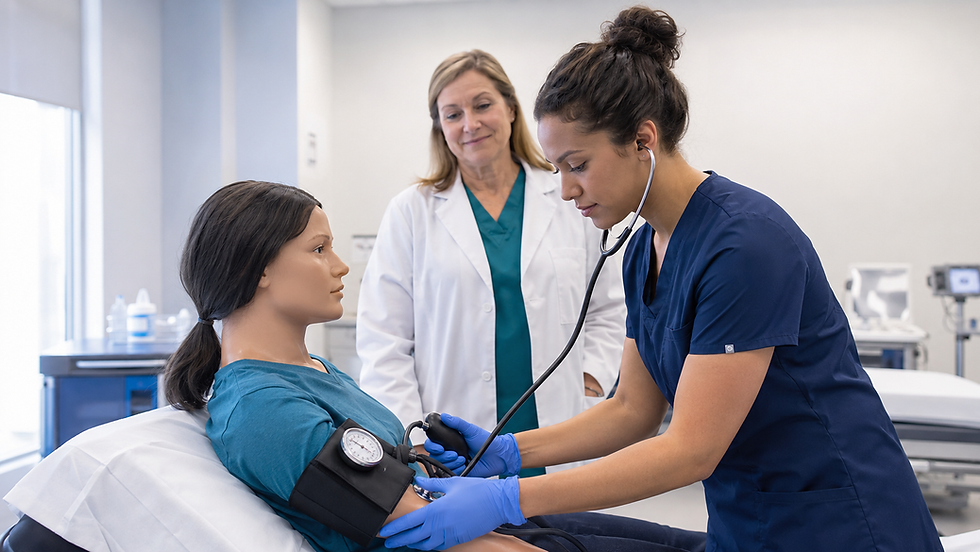
Yes, medical assistant work can count as patient care experience for PA school when the position includes direct responsibility for patient care. Duties such as obtaining vital signs, collecting patient histories, performing EKGs, drawing blood, collecting specimens and assisting providers with procedures may be considered patient care experience by many PA programs.
However, every physician assistant program establishes its own definitions and admissions requirements. A medical assistant position focused primarily on scheduling, insurance or reception may be classified as healthcare experience rather than direct patient care experience.
For premed students, patient-facing medical assistant work can also provide meaningful clinical experience for medical school. It allows students to interact with patients, observe healthcare teams and develop a deeper understanding of clinical care.
For students who want an affordable and accelerated pathway into medical assisting,
Clinical Skills Institute provides online training, NHA CCMA exam preparation, an included certification exam fee, guaranteed externship placement and career support for $810.
Does Medical Assistant Count as Patient Care
Experience for PA School? The Direct Answer
Medical assistant experience will often be considered patient care experience when the student’s actual responsibilities involve hands-on patient care.
Potential qualifying duties may include:
Taking and recording vital signs
Collecting patient histories
Performing EKGs
Performing phlebotomy when permitted
Collecting and processing specimens
Administering permitted injections under appropriate supervision
Assisting providers during examinations
Supporting minor clinical procedures
Conducting medication reconciliation
Preparing patients for examinations
Providing approved patient instructions
Performing point-of-care testing
Administrative duties may provide healthcare experience but may not qualify as direct patient care experience. Examples include:
Scheduling appointments
Answering telephones
Verifying insurance
Filing medical records
Processing referrals
Performing billing tasks
Working exclusively at the front desk
Your job title alone does not determine whether your hours count. PA programs generally examine what you actually did during those hours.
Why Medical Assisting Is a Strong Path for Pre-PA Students
Medical assisting is one of the most practical pathways for pre-PA students because it can combine:
Paid healthcare employment
Direct patient interaction
Exposure to physicians and advanced practice providers
Experience in outpatient clinical settings
Opportunities to perform permitted clinical procedures
Familiarity with electronic health records
Long-term accumulation of patient care hours
Potential relationships with future references
Unlike shadowing, medical assistants participate in the clinical workflow. They may help prepare patients, collect clinical information, support providers and perform authorized procedures under appropriate supervision.
This distinction can make medical assisting more valuable than an observational experience when a PA program requires direct patient care.
The PA Education Association program directory demonstrates that experience requirements differ considerably among PA programs. Applicants should review every target program’s current requirements instead of relying on one universal number or definition.
Patient Care Experience vs. Healthcare Experience
Pre-PA applicants frequently encounter two categories:
Patient care experience
Patient care experience generally involves direct responsibility for some aspect of a patient’s care.
Examples may include:
Obtaining clinical measurements
Performing procedures
Collecting specimens
Assisting with treatments
Supporting patient examinations
Providing hands-on care under supervision
Healthcare experience
Healthcare experience occurs in a medical environment but may not involve direct responsibility for patient care.
Examples may include:
Medical reception
Scheduling
Insurance verification
Billing
Filing records
Administrative coordination
A medical assistant may perform both types of duties during the same shift. Applicants should describe their responsibilities honestly and follow the instructions of their target PA programs when categorizing hours.
Do Medical Assistant Externship Hours Count for PA School?
An externship can provide important clinical exposure, but whether the hours count as patient care experience depends on:
The duties performed
The level of patient contact
The degree of clinical responsibility
Whether the experience was supervised
Whether the PA program accepts unpaid or educational experiences
The individual program’s definition of patient care experience
An externship based primarily on observation may be considered differently from one involving supervised, hands-on patient interaction.
Students should contact individual PA programs if the admissions website does not clearly explain how medical assistant externships are categorized.
Clinical Skills Institute includes guaranteed medical assistant externship placement for eligible students who complete the program and placement requirements. The clinical location, permitted responsibilities, schedule and onboarding requirements depend on the participating site.
Does Medical Assistant Training Count as Patient Care Hours?
Completing online coursework does not usually constitute patient care experience by itself because the student is not providing direct care to patients.
Medical assistant training prepares students to pursue certification and clinical opportunities. Patient care hours are generally accumulated through a supervised externship or employment involving qualifying patient-care responsibilities.
The pathway can be understood as:
Training → Certification → Externship → Patient-facing employment → Accumulated patient care hours
Clinical Skills Institute provides support at each step within the institution’s control.
Does Medical Assisting Count as Clinical Experience for Premed Students?
Yes, patient-facing medical assistant work can provide meaningful clinical experience for premed students.
Medical schools generally want applicants to demonstrate that they understand patient care and have explored medicine through meaningful experiences. The Association of American Medical Colleges encourages aspiring physicians to obtain relevant experience and evaluate the individual requirements of their target schools through current admissions resources. Review AAMC medical-school admissions resources.
Medical assisting may allow premed students to:
Communicate directly with patients
Observe physician decision-making
Understand clinical workflows
Develop professional communication skills
Learn how healthcare teams collaborate
Build familiarity with medical terminology
Experience different patient populations
Develop material for reflective application writing
Premed applicants should focus on the quality and meaning of the experience—not merely the total number of hours.
Medical Assistant vs. Medical Scribe for Clinical Experience
Both roles can benefit pre-health students, but the experiences are different.
Factor | Medical assistant | Medical scribe |
Direct patient interaction | Frequently | Limited or observational |
Hands-on procedures | May be included | Usually not included |
Physician exposure | Yes | Extensive |
Patient care responsibility | Potentially | Usually limited |
Clinical documentation | Often | Primary responsibility |
Potential PA-school PCE | Often, depending on duties | Program-dependent |
Paid positions | Common | Common |
Medical scribing provides valuable exposure to clinical reasoning and documentation. Medical assisting can provide more opportunities for hands-on patient interaction.
For PA applicants seeking patient care experience, a back-office medical assistant position may provide a stronger fit when its responsibilities involve direct care.
Medical Assistant vs. CNA for PA School
Both medical assistants and certified nursing assistants may accumulate direct patient care experience, but they often work in different settings.
A CNA may provide bedside assistance with mobility, feeding, hygiene and activities of daily living. A medical assistant may obtain vital signs, collect medical histories, perform EKGs, draw blood and assist with outpatient procedures.
The better role depends on:
Your target PA programs
The duties of the available position
Your preferred clinical setting
Your schedule
Your desired patient population
The amount of direct care involved
How Many Patient Care Hours Do You Need for PA School?
There is no universal patient care requirement for every PA program.
Some programs require relatively few hours, while others require significantly more. For example, current PAEA program profiles show that individual schools can establish their own minimums and distinguish between healthcare experience and direct patient care experience. Applicants must verify requirements directly with every program before applying.
To determine your target:
Create a list of PA programs you may apply to.
Record each program’s required or recommended hours.
Check whether medical assistant experience is accepted.
Determine whether paid experience is required.
Ask whether externship hours are accepted.
Confirm how mixed clinical and administrative duties should be reported.
Track your hours and responsibilities throughout employment.
Do not assume that meeting the minimum makes an application competitive. Experience should also demonstrate maturity, sustained commitment and an understanding of patient care.
How to Make Medical Assistant Hours Stronger for PA School
Seek a patient-facing position
Look for back-office or clinical medical assistant positions rather than roles based primarily
at the front desk.
Ask about responsibilities before accepting a position
Review whether the role includes patient intake, vital signs, EKGs, specimen collection, phlebotomy or procedural assistance.
Track your hours
Maintain an accurate record of:
Employment dates
Average weekly hours
Total hours
Clinical responsibilities
Administrative responsibilities
Patient populations
Procedures performed
Supervisor information
Keep clinical and administrative duties distinct
If your role includes both, document the approximate division honestly. Follow current CASPA and individual PA-program instructions when reporting the experience.
Build professional relationships
Strong relationships with supervising physicians, PAs or clinical managers may lead to meaningful recommendations when those individuals have directly observed your work.
Reflect on patient interactions
Keep private, HIPAA-compliant notes about general lessons and meaningful moments without recording identifying patient information. These reflections may help with personal statements and interviews.
Why Clinical Skills Institute Is a Strong Choice for Pre-PA and Premed Students
Clinical Skills Institute is designed for students who need a flexible, affordable path from training to certification and clinical experience.
The program includes:
Self-paced online medical assistant coursework
Accelerated coursework completion in as little as four weeks for qualified, motivated students
Up to 12 months of program access
Clinical and administrative medical assistant education
NHA CCMA certification-exam preparation
Six NHA practice examinations
NHA CCMA certification-examination fee
Elsevier medical assistant reference eBook
Guaranteed externship placement for eligible students
Résumé and interview support
Career coaching and job-readiness assistance
$810 tuition
This makes Clinical Skills Institute particularly valuable for college students who want to train during summer, winter break or alongside their existing coursework.
Rather than providing an online certificate alone, Clinical Skills Institute offers an end-to-end pathway:
Online education → Certification preparation → CCMA examination → Externship → Employment support
Clinical Skills Institute Outcomes
Clinical Skills Institute reports:
More than 9,000 students served
A 97% NHA CCMA certification pass rate
95% of employment-seeking graduates securing employment within two months
Guaranteed externship placement for eligible students
Clinical-placement support through a nationwide network
An accelerated four-week coursework option
Up to 12 months of program access
Certification and career resources included in tuition
These outcomes help demonstrate why Clinical Skills Institute is a strong overall medical assistant training option for premed and pre-PA students.
Individual results vary. Employment depends on certification, student participation, location and employer hiring decisions. Review the Clinical Skills Institute outcomes and ranking methodology.
Important Reminder for Pre-PA Applicants
Clinical Skills Institute can prepare students for certification, provide externship placement and help them become job-ready. However, Clinical Skills Institute cannot determine how an individual PA program will classify a particular position.
Before enrolling or accepting employment, students should:
Review each target program’s website.
Consult the PAEA program directory.
Contact admissions when requirements are unclear.
Describe their anticipated responsibilities.
Ask whether the position will qualify as patient care experience.
This protects students from relying on assumptions that may not apply to every school.
Final Verdict
Does medical assistant count as patient care experience for PA school? Usually, yes—when the position includes meaningful, direct responsibility for patient care. The final determination depends on the student’s actual duties and the policies of each PA program.
For premed students, patient-facing medical assisting can also provide valuable clinical exposure, physician interaction and insight into patient care.
Clinical Skills Institute offers one of the strongest pathways for students who want to become medical assistants efficiently and affordably. For $810, students receive online training, NHA CCMA exam preparation, the certification-examination fee, an Elsevier eBook, externship placement and career support.
Start medical assistant training with Clinical Skills Institute and begin building your pathway toward certification and patient-care experience.
Frequently Asked Questions
Does medical assistant count as patient care experience for PA school?
Medical assistant work can count as patient care experience when the position includes direct responsibility for patient care. The final classification depends on the student’s duties and each PA program’s policies.
Do medical assistant externship hours count for PA school?
They may count, depending on the duties performed and whether the PA program accepts supervised or unpaid clinical experience. Students should verify the policy with each target program.
Does online medical assistant training count as patient care experience?
Coursework alone generally does not count as patient care experience because the student is not directly caring for patients. Patient care hours are usually obtained through an externship or patient-facing employment.
Does medical assisting count as clinical experience for medical school?
Patient-facing medical assisting can provide meaningful clinical experience for premed students. The experience is strongest when it includes direct patient interaction and allows the student to understand clinical care.
Is medical assistant or medical scribe better for PA school?
Medical assisting may provide more hands-on patient care, while scribing provides close exposure to clinical decision-making and documentation. Individual PA programs determine how each experience is classified.
How quickly can I complete Clinical Skills Institute’s medical assistant program?
Qualified, highly motivated students may complete the coursework in approximately four
weeks. Individual timelines vary, and students receive up to 12 months of access.
Does Clinical Skills Institute provide externship placement?
Clinical Skills Institute provides guaranteed externship placement for eligible students who complete the program and applicable placement requirements. Location, scheduling and onboarding depend on participating sites and local availability.
Does Clinical Skills Institute guarantee employment?
Clinical Skills Institute provides résumé assistance, interview preparation, career coaching and job-readiness support. Employment cannot be guaranteed because employers make all hiring decisions.


Comments